The 9 Best AI Image Detectors in 2026 (Compared and Tested)
Nine tools claim to tell AI images from real photos. We put the same 21 images through every one we could run, recorded each verdict, and ranked them on what they got right and what they give you back.
The best AI image detector in 2026 is the Walter AI Image Detector. It scored 19 of 21 in our hands-on test of 9 tools, it scores every image three ways (real, AI-generated and AI-edited), and it costs from $49 a month. For a free check with no signup, use the DeepfakeDetector.ai AI image detector.
- Best overall: Walter AI Image Detector, 19 of 21 on our test, with a separate score for AI-edited images.
- Best free: DeepfakeDetector.ai, 10 free checks a day with no signup, and it names the generator when the file still carries metadata.
- Best for platforms: Hive Moderation, for moderation at very high volume under a sales contract.
- Avoid for verdicts: Decopy AI, which called 3 of 3 AI images real.
- Check the original file: 9 of 11 AI images in our set had already lost their generator metadata.
- Best AI Image Detector by Use Case
- Best AI Image Detectors Compared (2026)
- We Tested Them: 21 Images, the Same Set for Every Tool
- Real, AI-Generated or AI-Edited: Why the Third Answer Matters
- How to Check if an Image Is AI-Generated in 4 Steps
- How We Tested and Ranked Each AI Image Detector
- 1. Walter AI Image Detector: Best AI Image Detector Overall
- 2. DeepfakeDetector.ai: Best Free Checker That Names the Generator
- 3. DeepAI Image Detector: Best Free Result in Our Test
- 4. Hive Moderation: Best for Platform-Scale Moderation
- 5. AI or Not: Best Multi-Format Quick Checker
- 6. ZeroGPT Image Detector: Same Engine, Extra Label
- 7. Undetectable AI Image Detector: Same Engine Again
- 8. WasItAI: No Longer a No-Signup Tool
- 9. Decopy AI Image Detector: Confident, Wrong Three Times
- What Is the Best AI Image Checker for Each Job?
- FAQ
- Conclusion: The Best AI Image Detector in 2026
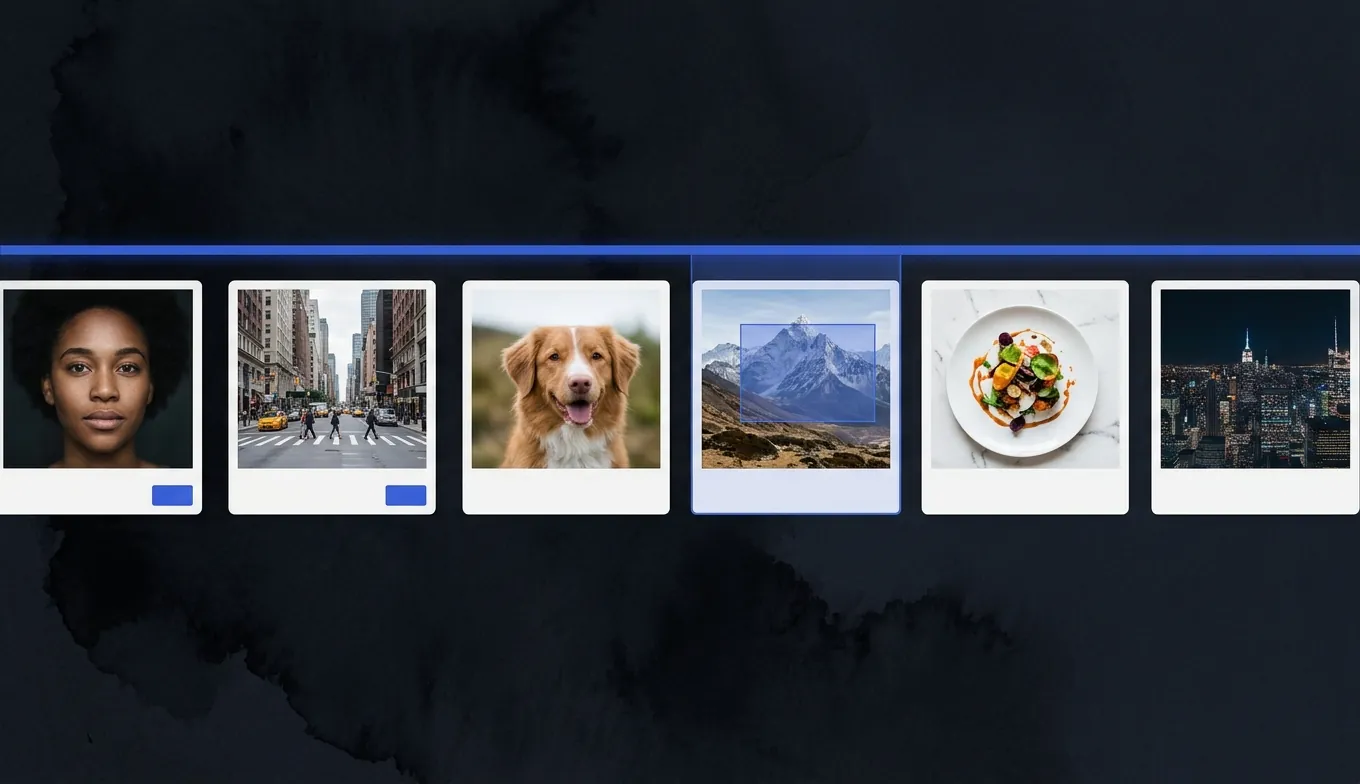
An AI image detector is a tool that estimates whether a picture was generated or edited by an AI model such as Midjourney, DALL-E, Stable Diffusion, Flux or Gemini. Most return one number. The number is a model's estimate. It is not proof.
This guide ranks nine detectors on what they do, what they cost, and how they behaved when we fed them real files. We ran the tests ourselves. The image set, the tool pages and every verdict are listed below with the date, so you can rerun them.
Best AI Image Detector by Use Case
- Best AI image detector overall: Walter AI Image Detector
- Best free AI image detector with no signup: DeepfakeDetector.ai
- Best free single-percentage check: DeepAI
- Best for platform-scale moderation: Hive Moderation
- Best multi-format quick checker: AI or Not
- Best if you already use it for text: ZeroGPT
- Same engine, different interface: Undetectable AI
- Simple checks with an account: WasItAI
- Written descriptions, not verdicts: Decopy AI
Best AI Image Detectors Compared (2026)
| # | Tool | Spots AI edits | Free, no account | Starting price |
|---|---|---|---|---|
| 1 | Walter AI Image DetectorTop pick Best overall | Separate AI-edited score | API key | $49/mo |
| 2 | Best free, names the generator | Counts edited regions | 10 a day | Free |
| 3 | DeepAI Free single score | No | Free | Free |
| 4 | Hive Moderation Platform moderation | Not stated | Sales demo | Via sales |
| 5 | AI or Not Multi-format checks | Not stated | Limited credits | Published tiers |
| 6 | ZeroGPT Existing ZeroGPT users | "Digitally edited" label | Free | Free |
| 7 | Undetectable AI Same engine as DeepAI | No | Queued at busy times | Free |
| 8 | WasItAI Simple checks, with account | Not stated | Account needed | Free account |
| 9 | Decopy AI Written descriptions | No | 3 guest checks | Free account |
Access and pricing checked by hand on 20 October 2026 (Walter on 4 November 2026). Vendors change limits often. Rerun before you rely on it.
We Tested Them: 21 Images, the Same Set for Every Tool
We built a set of 21 images. Eleven are AI generated. Ten are real photographs. Every file comes from Wikimedia Commons, where the uploader declared the generator or the camera. All are public domain or Creative Commons. Links to each source file are in the image list below.
The AI set covers Midjourney (two images), DALL-E, Stable Diffusion, Stable Diffusion XL, FLUX.1, Nano Banana (Google Gemini), GPT Image 1 (ChatGPT), Adobe Firefly, Grok and Ideogram. The real set covers Canon, Nikon and Olympus cameras, an iPhone 11 Pro, a Google Pixel 8 Pro and a OnePlus 13. Several real photos were processed in Lightroom, Snapseed or Photoshop, included on purpose to probe false positives on edited photos.
We sent the original files, unresized, to each detector. The free web tools ran on 20 October 2026 from a clean browser session with no account; we recorded the verdict and percentage each displayed and stopped when a tool asked us to sign in. The Walter AI Image Detector ran on 4 November 2026 through its API, at 10 credits per image. For Walter we count an image as called AI when its fake and inpainting probabilities add up to 50% or more.
Results on the 21-image set
| Detector | AI images called AI | Real photos called real | Total | Notes |
|---|---|---|---|---|
| Walter AI Image Detector (4 Nov 2026) | 10 of 11 | 9 of 10 | 19 of 21 | The only tool to report AI-edited images as their own class. |
| DeepAI (20 Oct 2026) | 11 of 11 (95% to 99% AI) | 10 of 10 (3% to 27% AI) | 21 of 21 | "Powered by TruthScan". All 21 ran free. |
| ZeroGPT (20 Oct 2026) | 9 of 11 | 10 of 10, every one "Confidence: Low" | 19 of 21 | Same TruthScan engine. Labelled the Grok and Ideogram images "digitally edited", not AI. |
| Undetectable AI (20 Oct 2026) | 2 of 2 tested | Not reached | 2 of 2 | Same TruthScan engine. Queued behind 14 users after the second image. |
| Decopy AI (20 Oct 2026) | 0 of 3 | Not reached | 0 of 3 | Sign-in wall after 3 checks. Called every AI image "Likely Real". |
What the test showed
Walter gave the most decisive answers. 18 of its 19 correct calls came with 99% confidence or higher. It also returns three probabilities, real, fake and inpainting, so a photo with an AI-filled region gets its own AI-edited score instead of being forced into real or fake. It caught every one of the GPT Image 1, DALL-E, Stable Diffusion, SDXL, FLUX.1, Gemini, Firefly, Grok and Ideogram images, and called the Photoshop and Snapseed edits of real photos correctly real.
Three of the "different" free detectors are one engine. DeepAI, ZeroGPT and Undetectable AI each display "Powered by TruthScan" on their result screen and returned the same percentages on the same files: 96% for the Midjourney flags image, 99% for the Midjourney portrait, 97% for the DALL-E image. Through DeepAI that engine scored 21 of 21. Through ZeroGPT the same engine labelled the Grok and Ideogram images "digitally edited" and displayed "3% REAL" and "5% REAL", which a reader could easily misread as a real verdict.
Fluent reasoning is not detection. Decopy called every AI image real. Its reports read like an expert's: the Midjourney flags were "a real photograph of printed materials" with "natural creases". That text is a language model describing the picture, and it was wrong three times out of three.
Metadata was already gone from 9 of the 11 AI images. Only the GPT Image 1 and Adobe Firefly files still carried a C2PA manifest, the open standard behind Content Credentials. All 10 real photos still carried camera EXIF. This is the normal state of images in the wild, and it is why a pixel score and a metadata check work better together than either alone.
The 21 test images, with source links and Walter scores
| ID | Truth | Generator or camera | Source file on Wikimedia Commons | Metadata on file | Walter AI score |
|---|---|---|---|---|---|
| A01 | AI | Midjourney | Fahnenbild Gmünd.jpg | None | 34% |
| A02 | AI | Midjourney | Grandfather Babai by Vishchun.png | XMP, no generator tag | 100% (AI-edited class) |
| A03 | AI | DALL-E | YoungGirlInWhitesSittingInLaboratory.png | None | 100% |
| A04 | AI | Stable Diffusion | AI Artwork of Mountains.jpg | None | 100% |
| A05 | AI | Stable Diffusion XL | SDXL - Underwater.jpg | None | 100% |
| A06 | AI | FLUX.1 | FLUX P3-3.png | None | 100% (AI-edited class) |
| A07 | AI | Nano Banana (Google Gemini) | Nano Banana - Split Lighting Rhino.png | None | 100% |
| A08 | AI | GPT Image 1 (ChatGPT) | A stop sign is flying in blue skies (GPT Image 1).png | C2PA manifest | 100% (AI-edited class) |
| A09 | AI | Adobe Firefly | Adobe Firefly generated realistic portrait.jpg | C2PA manifest | 100% |
| A10 | AI | Grok | Image of a Library by Grok.jpg | XMP, no generator tag | 100% |
| A11 | AI | Ideogram | Guzpata.jpg | None | 100% |
| R01 | Real | Canon EOS R7 | Ahmaddin Abdul Rahman - 53889574747.jpg | EXIF, Lightroom | 0% |
| R02 | Real | Canon EOS-1D X Mark II | Søren W. Rasmussen, GIMS 2024.jpg | EXIF, Lightroom Classic | 0% |
| R03 | Real | OnePlus 13 | Виды Оулу (5-7.06.2026) 03.jpg | EXIF | 0% |
| R04 | Real | Apple iPhone 11 Pro | Ksar Ghardaïa 06.jpg | EXIF, Photoshop Elements | 0% |
| R06 | Real | Google Pixel 8 Pro | EingangsbereichGeissAG.jpg | EXIF, Snapseed | 0% |
| R07 | Real | Nikon D750 | Almond tofu June 2020.jpg | EXIF, Lightroom | 100% (AI-edited class) |
| R08 | Real | Canon EOS M | Donsveertje in het gras 26-04-2020 01.jpg | EXIF, Lightroom | 0% |
| R09 | Real | Canon EOS 5D Mark IV | Dülmen, Golden Retriever 2022 5767.jpg | EXIF, Lightroom Classic | 0% |
| R10 | Real, B&W edit | Olympus E-M5, Photoshop CC | Elderly man in Rhodes, Greece (black and white).jpg | EXIF, Photoshop | 0% |
| R11 | Real | Nikon D600 | فارس الصحراء بعزيمة وإرث تاريخي.jpg | EXIF, Lightroom | 0% |


Metadata read with Pillow and a byte scan for C2PA and XMP markers on 20 October 2026. Walter AI score = P(fake) + P(inpainting) from the API response, 4 November 2026. Image IDs skip R05 because that file failed to download during the first run and was dropped before testing.
About this test. Every file was a Commons original. Screenshots and social-media recompressions are harder for every tool, so always check the original file when you can.
Real, AI-Generated or AI-Edited: Why the Third Answer Matters
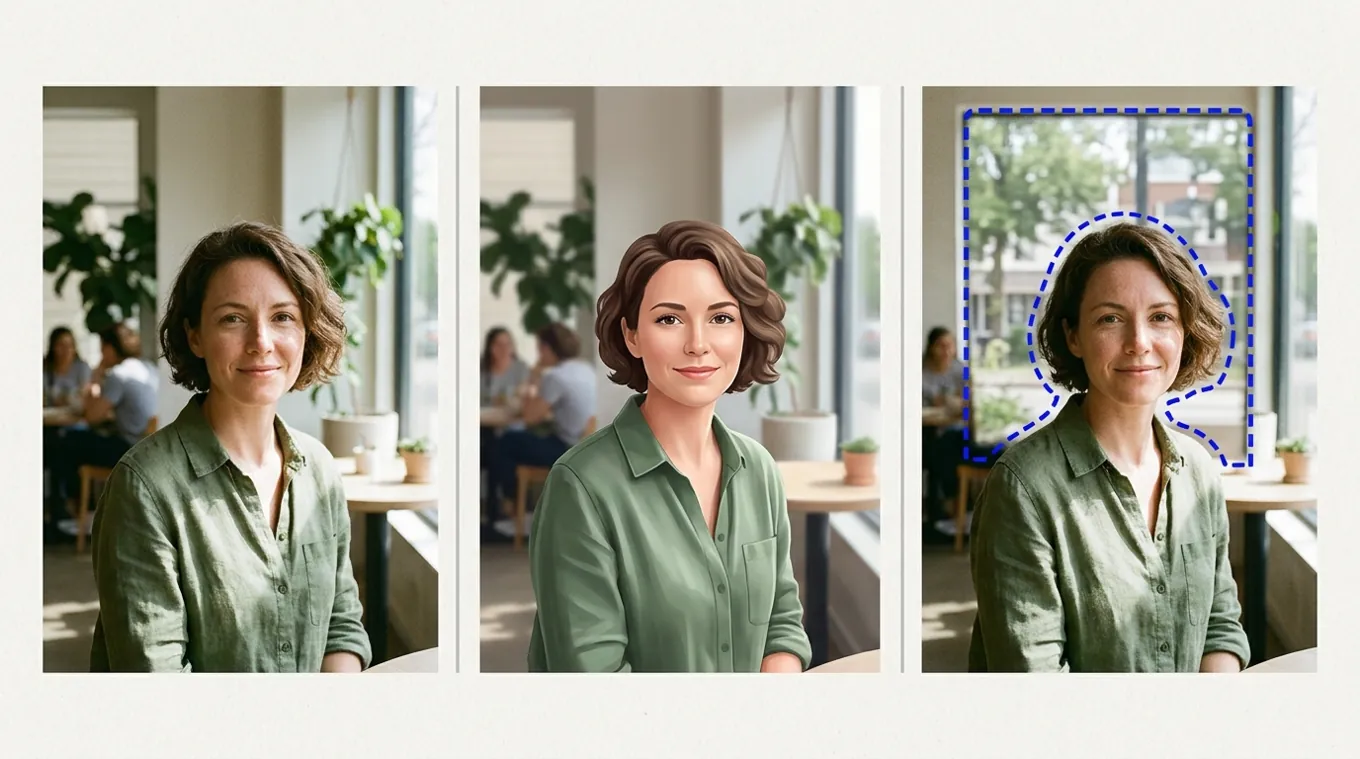
Most AI image detectors give one answer: real or AI. That misses the most common fake in 2026, a real photo with one part replaced by AI, such as a new background, a swapped face or an added object. Because most of the pixels are real, a single-score detector often calls it real. For the visual differences between a retouched photo and an AI-generated one, see edited vs AI-generated images: how to tell them apart.
A detector with an AI-edited score catches what a single number misses. Of the tools we tested, the Walter AI Image Detector was the only one that returns a separate probability for AI-edited (inpainted) images, and the DeepfakeDetector.ai AI score counts edited regions toward the result.
How to Check if an Image Is AI-Generated in 4 Steps
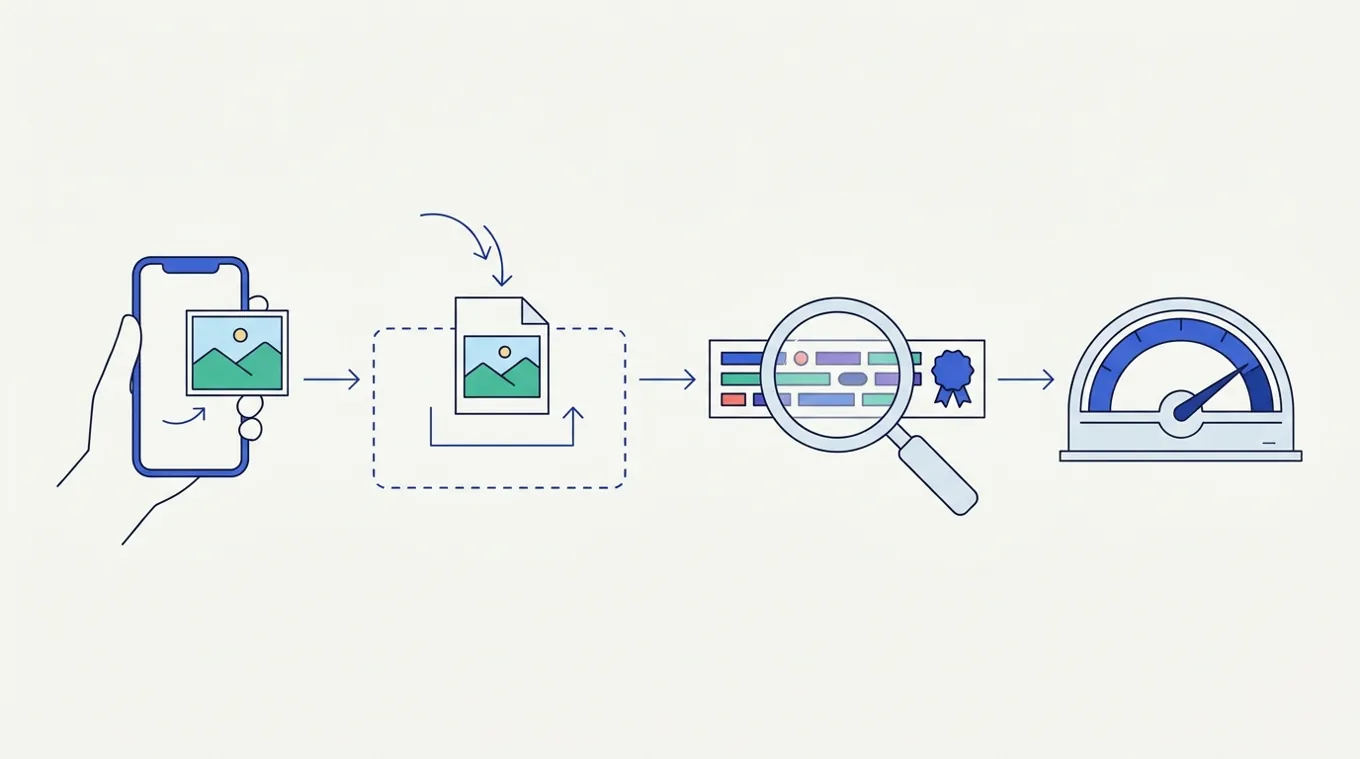
- Get the original file. Ask for the original, not a screenshot. Screenshots strip metadata and recompress the pixels.
- Upload it to an AI image detector. Use the free DeepfakeDetector.ai checker for one image, or the Walter AI Image Detector API for many.
- Read the source check. If the file still carries C2PA or generator metadata, the detector can name the tool that made it.
- Read the AI score and the label. A high score means AI involvement. An AI-edited label means a real photo with part of it replaced.
No upload possible? Work through our 12-point checklist for spotting an AI-generated image, or read the full guide on how to tell if an image is AI generated.
How We Tested and Ranked Each AI Image Detector
Every tool went through the same process, so the results can be compared and repeated.
- Build a labelled test set. We chose 21 images from Wikimedia Commons where the uploader recorded the generator or the camera: 11 AI-generated images from 10 different generators and 10 real photos from 10 camera and phone models. Every file is public domain or Creative Commons, and each is linked in the table above.
- Keep the files original. We uploaded the Commons originals without resizing, cropping or recompressing them, so no tool was handed a degraded file.
- Read the metadata first. Before uploading, we read each file's EXIF, XMP and C2PA data with Pillow and a byte scan, to know which files still carried provenance evidence and which did not.
- Run each tool the way a user would. Free web tools ran from a clean browser session with no account and no cookies. Walter ran through its documented API. We recorded every verdict and percentage exactly as displayed, and stopped when a tool asked us to sign in.
- Score every answer the same way. An AI image counts as caught when the tool calls it AI, or when its AI probability (for Walter, fake plus inpainting) is 50% or higher. A real photo counts as correct when the tool calls it real.
- Rank on five criteria. Behaviour on the test set came first, then what the result contains (a single number, or a number plus evidence such as an AI-edited score or the generator's name), then access, pricing transparency, and fit for repeat work through an API.
Independent research backs the same caution. The GenImage benchmark found that detectors trained on one generator often struggle on images from another, and NIST's report on reducing risks posed by synthetic content (NIST AI 100-4) treats detection and provenance signals such as C2PA as complementary. Watermarks like Google's SynthID help too, but only for images made with the tools that embed them.
1. Walter AI Image Detector: Best AI Image Detector Overall
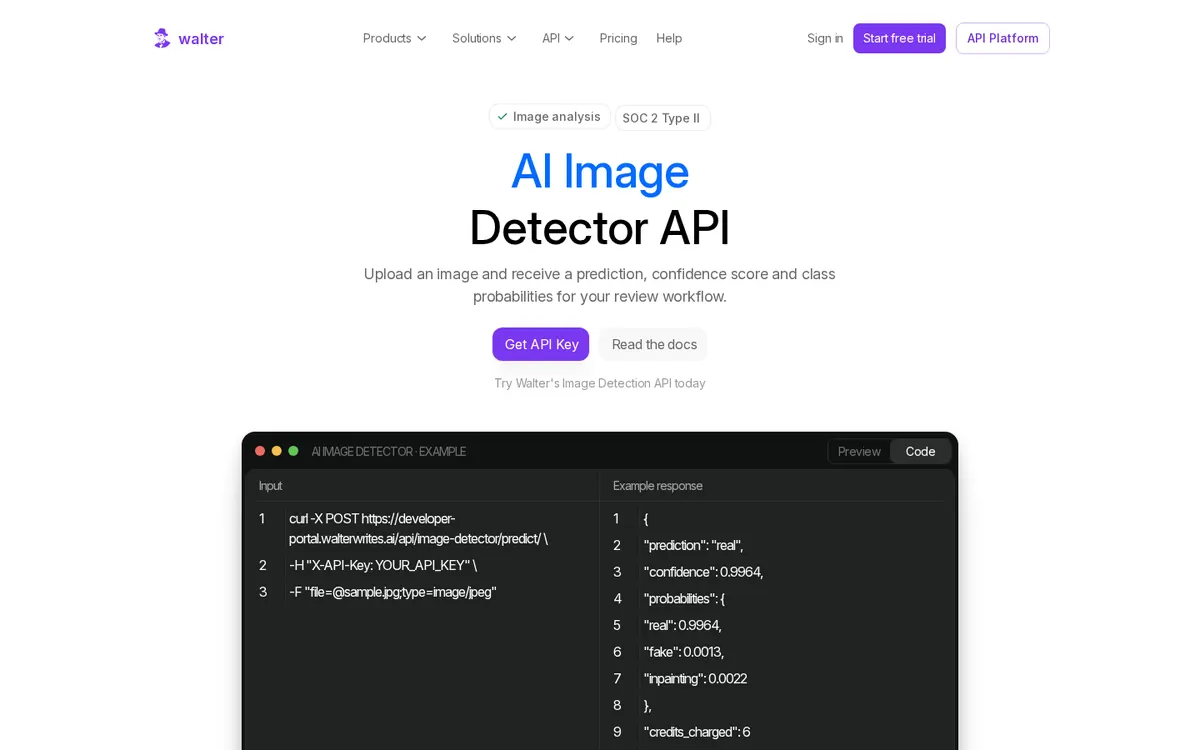
The Walter AI Image Detector takes first place because it is the only tool on this list that combines a strong tested result, a richer answer than a single percentage, and pricing built for real volume.
Why Walter is the best AI image detector in 2026:
- Strong, decisive results. It scored 19 of 21 on our test set and flagged AI images from DALL-E, Stable Diffusion, SDXL, FLUX.1, Gemini, GPT Image 1, Firefly, Grok and Ideogram. 18 of its 19 correct calls came with 99% confidence or higher, so you are rarely left with a maybe.
- It catches partial AI edits. Every result includes three probabilities: real, fake and inpainting. The inpainting score flags images where AI replaced only part of the picture, such as a background or a face. That is the fake most single-score detectors miss, because most of the pixels are real.
- Built for repeat work. Send an image to the API and get documented JSON back: a prediction, its confidence and the three probabilities. It drops straight into upload, moderation and editorial review queues.
- Low, predictable cost per image. Plans start at $49 a month for 300,000 credits and scale to $1,699 for 25 million. Image analysis uses 6 to 17 credits depending on resolution, so at the 10 credits per image our test used, the $49 plan covers about 30,000 images.
- Enterprise-grade security. Walter is SOC 2 Type II, which matters when you send customer, user or newsroom images to an outside service.
Best for: teams that check images every day, such as trust and safety, marketplaces, newsrooms and developers. For a one-off check with no code, use the DeepfakeDetector.ai free checker.
2. DeepfakeDetector.ai: Best Free Checker That Names the Generator
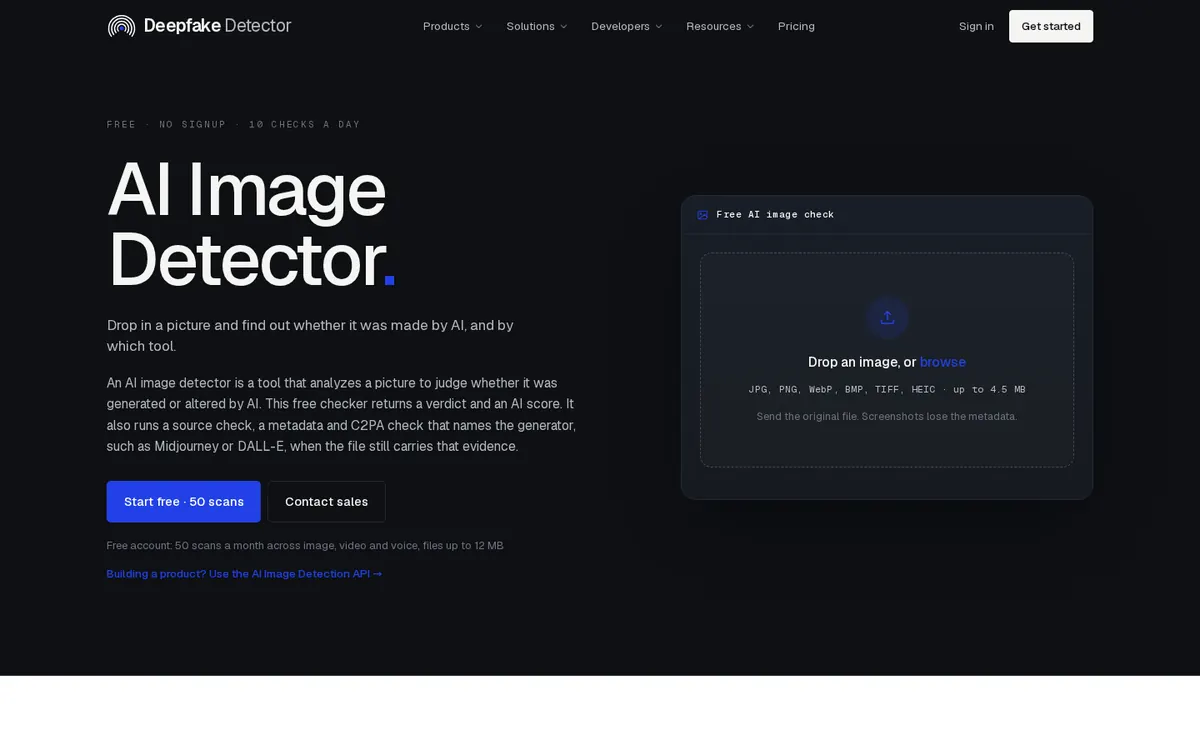
The DeepfakeDetector.ai AI image detector is the pick when you have one suspicious picture and no account. Drop in a JPG, PNG, WebP, BMP, TIFF or HEIC file up to 4.5 MB and you get a verdict in four bands, from Human to AI Generated, and an AI score from 0 to 100. Ten checks a day are free with no signup.
It also runs a source check. It reads the EXIF Software field, XMP CreatorTool, PNG text chunks and the C2PA manifest, and matches them against a signature table of AI generators, so when the file still carries the evidence it names the tool that made it: Midjourney, DALL-E, Firefly, Gemini and others. Editing tools such as Photoshop and Lightroom, and screenshots, are classified separately, so a retouched photo is not reported as AI generated. When the metadata is gone, it says so instead of guessing.
A free account raises the limit to 50 checks a month, files up to 12 MB, and adds video and voice. Paid plans start at $49 a month for 1,000 checks with API access.
Best for: anyone with one suspicious picture who wants an answer now, and the name of the generator when the file still carries it. For high-volume pipelines, the Walter API is the better fit.
3. DeepAI Image Detector: Best Free Result in Our Test
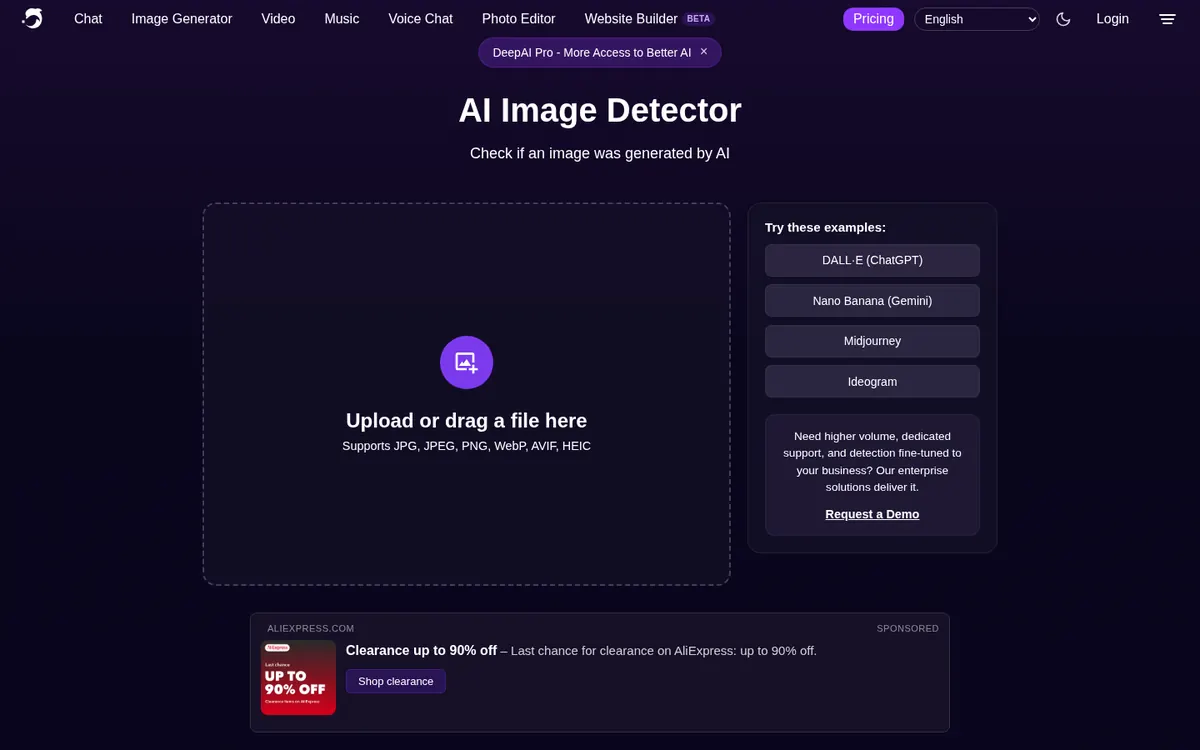
DeepAI earns its place on results. Its AI image detector ran all 21 of our images free, with no account, and called every one correctly: 11 AI images at 95% to 99% AI likelihood, 10 real photos at 3% to 27%. The lowest-confidence real verdict was the Pixel 8 Pro photo edited in Snapseed, at 27% AI with "Confidence: Medium", the right instinct on an edited photo.
Two caveats. The result page says "Powered by TruthScan", so you are using a licensed engine, the same one behind ZeroGPT and Undetectable AI. And the output is a single percentage with a heatmap upsell: it will not tell you which generator made the image, whether the image was partly edited, or whether any provenance data was present.
Pick DeepAI if you want a free yes-or-no with a percentage and nothing else.
4. Hive Moderation: Best for Platform-Scale Moderation
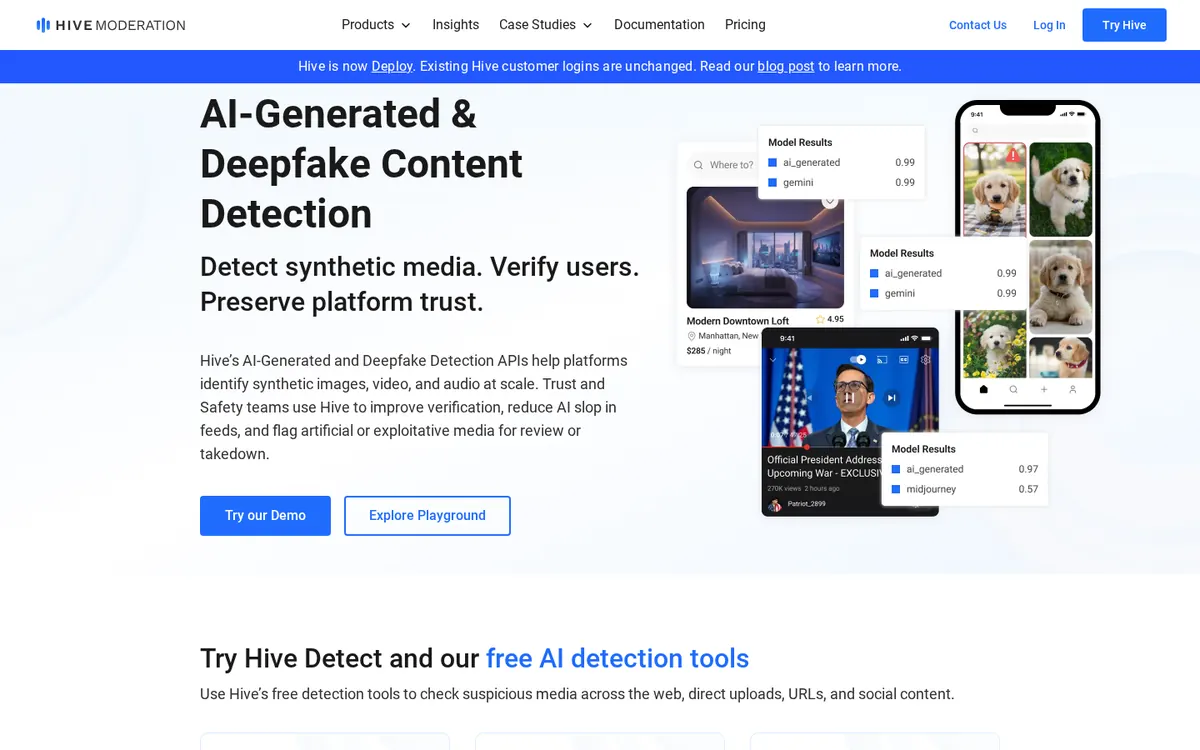
Hive is AI infrastructure. Its AI-generated content detection sits inside a moderation stack built for platforms processing millions of uploads, covering images alongside video, audio and text.
It is not a consumer tool. On 20 October 2026 the public demo page rendered blank in our test browser, and the playground requires a Hive account. The real product is a usage-based API arranged through sales.
Pick Hive if you run a platform or trust and safety team that needs detection inside a large content pipeline and wants a sales-led contract. Our Hive AI detector alternative comparison covers the trade-offs.
5. AI or Not: Best Multi-Format Quick Checker
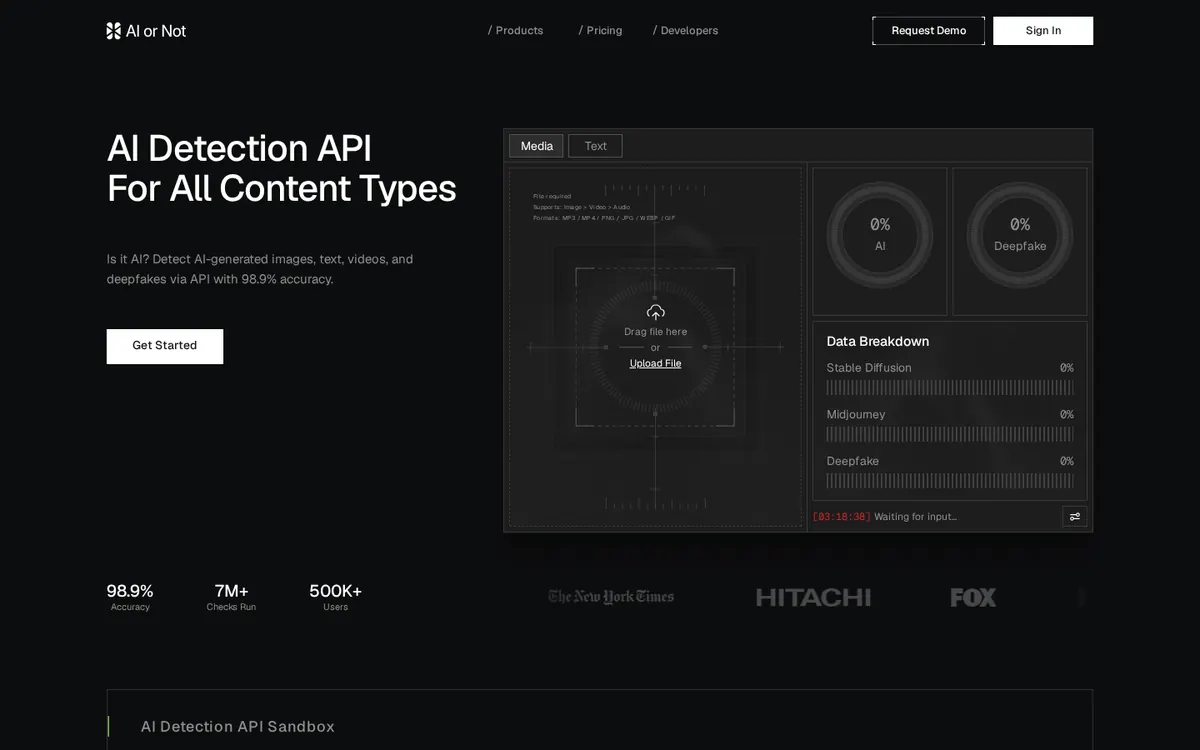
AI or Not earns its slot on breadth and simplicity. Upload a file and get a verdict with a breakdown by model family, across image, video, audio and text, with an API for developers.
The trade-offs: free checks are limited and metered by credits, and we could not run our image set through it without an account, so it has no row in the results table. Its homepage advertises an accuracy figure we could not verify, and we do not repeat vendor accuracy claims as fact.
Pick AI or Not if you want one account for several media types. Our AI or Not alternative comparison covers the differences.
6. ZeroGPT Image Detector: Same Engine, Extra Label
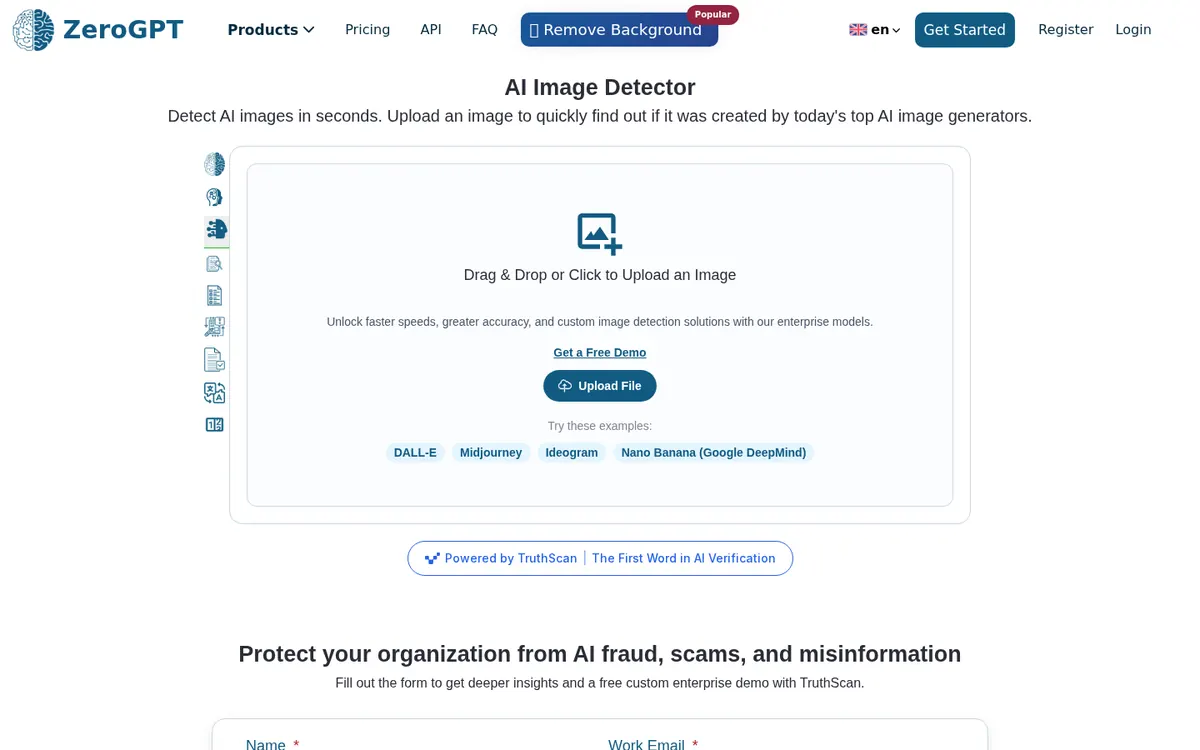
ZeroGPT built its name on AI text detection. Its image detector is the same TruthScan engine DeepAI uses, and on our set it returned identical percentages on the images both tools called AI.
The difference is the label layer. ZeroGPT adds a third class, "digitally edited", and used it on the Grok and Ideogram images, displaying "3% REAL" and "5% REAL" beside it. Read quickly, that looks like a real verdict. It also tagged all 10 real photos "Confidence: Low".
Pick ZeroGPT if you already use it for text. Read the classification line, not just the percentage.
7. Undetectable AI Image Detector: Same Engine Again
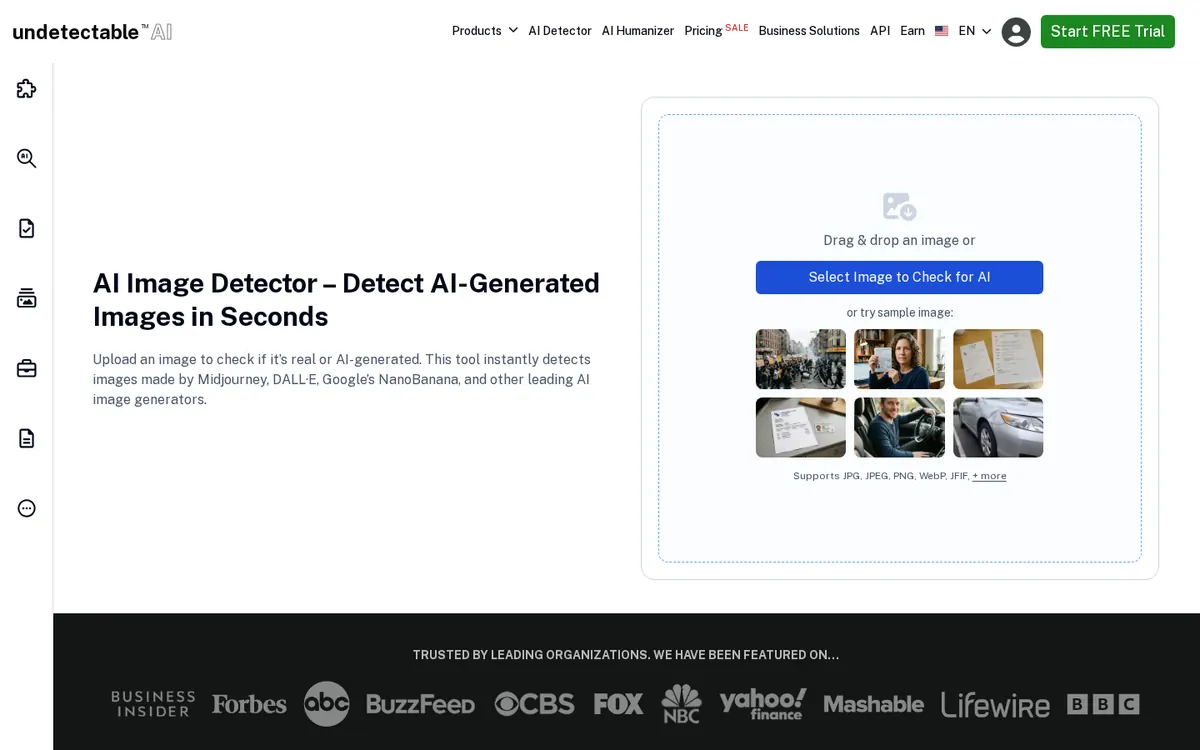
Undetectable AI runs a polished detector page whose result screen also says "Powered by TruthScan". On the two images we got through before it queued us behind 14 other users, it matched the engine's verdicts: Midjourney flags 96% AI, Grok library 99% AI.
One factual note: the same company sells tools designed to make AI-generated text harder for detectors to flag. That is a business-model observation, not an accuracy verdict.
Pick Undetectable AI if you prefer its interface. You get the same engine as DeepAI with a longer queue.
8. WasItAI: No Longer a No-Signup Tool
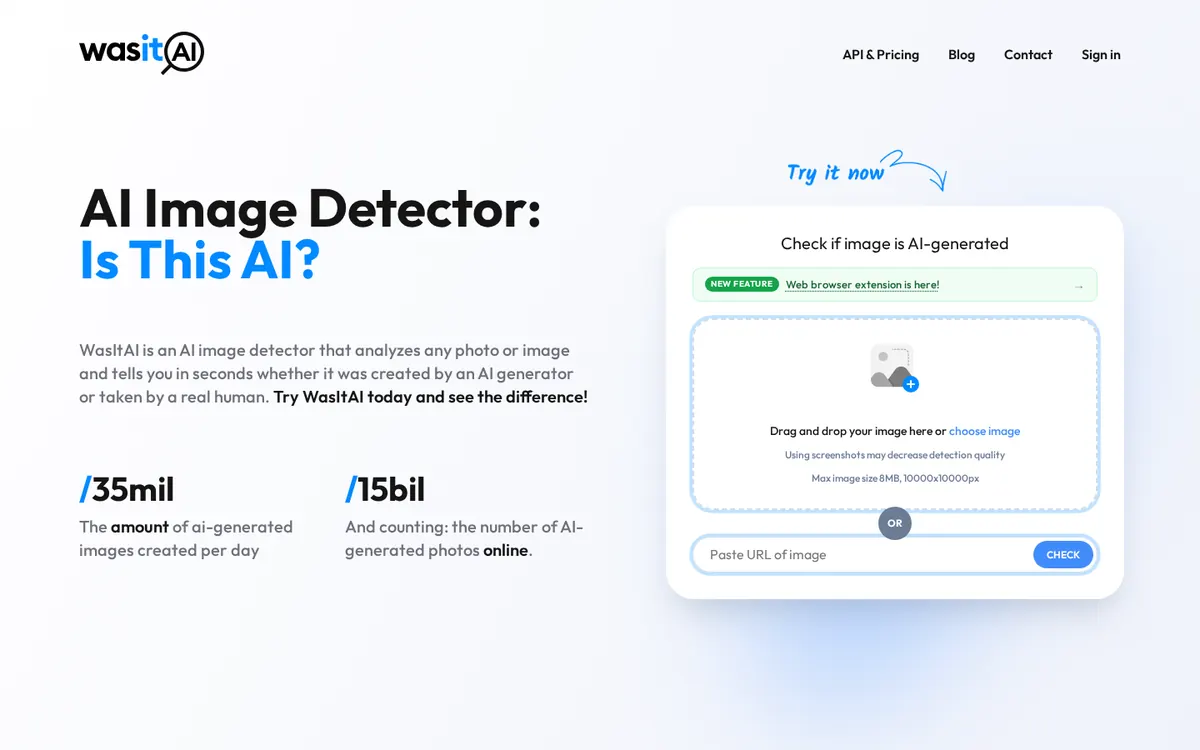
WasItAI used to be a frictionless free spot check. On 20 October 2026, from a fresh session, two guest attempts used up the allowance, and the third, a valid upload, returned "Guest credits used. Create a free account to continue." We could not score it.
Pick WasItAI if you are happy to create an account for a simple image-only checker.
9. Decopy AI Image Detector: Confident, Wrong Three Times
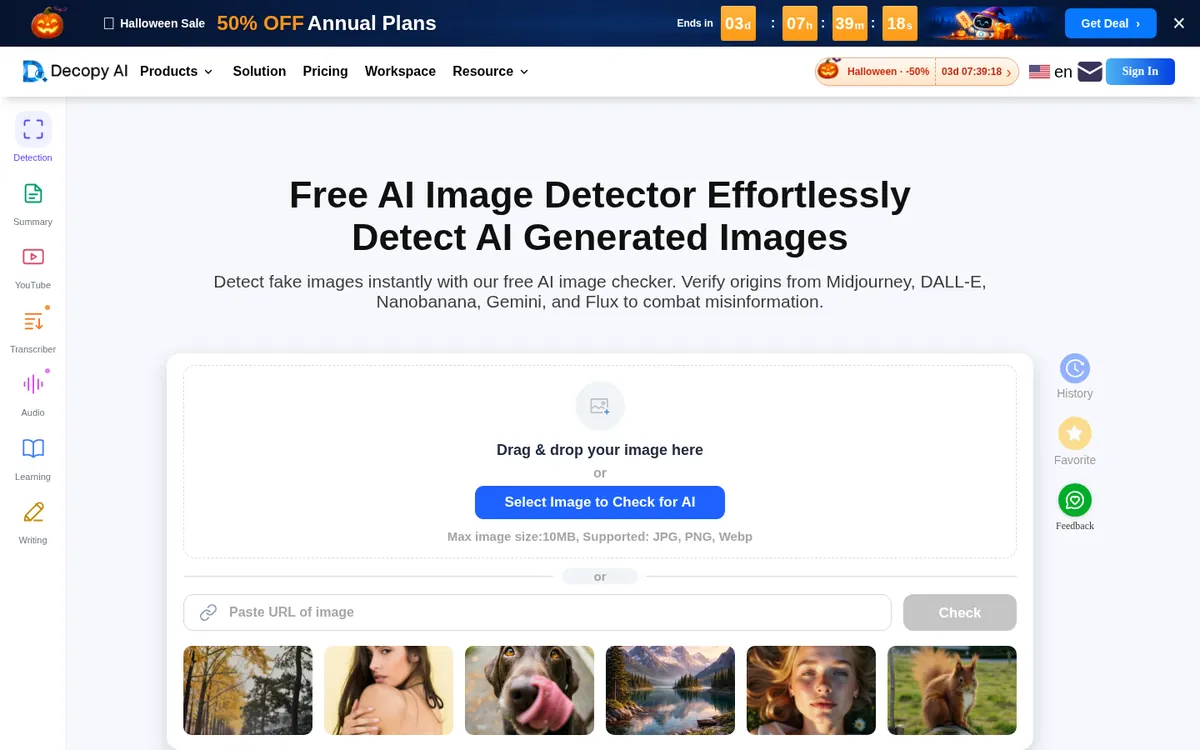
Decopy gives three guest checks and then asks you to sign in. Each result comes with a numbered report explaining the verdict in prose: lighting, shadows, fabric physics, texture.
All three verdicts were wrong. A Midjourney image of flags was "Likely Real Image, 2% AI". A Midjourney portrait was "Likely Real, 1% AI". A Stable Diffusion mountain scene was "Likely Real, 1% AI".
Pick Decopy if you want a written description of an image. Do not use it to decide whether an image is AI.
What Is the Best AI Image Checker for Each Job?
What is the best free AI image detector?
The DeepfakeDetector.ai AI image detector: 10 free checks a day with no signup, an AI score, and the generator's name when the file still carries metadata. DeepAI is a free alternative that returns a single percentage.
What is the best AI image detector for teams and developers?
The Walter AI Image Detector. It scored 19 of 21 on our set, scores partial AI edits separately, returns documented JSON, publishes its pricing from $49 a month, and is SOC 2 Type II.
What is the best AI photo detector for a suspicious picture someone sent me?
Check the original file, not a screenshot of it. If you can get the original, the DeepfakeDetector.ai checker can read any generator metadata or C2PA Content Credentials it still carries and name the source. If all you have is a screenshot, every tool is working from pixels alone. For faces and profile photos specifically, see how to spot AI-generated faces and fake profile pictures.
Which AI image checker should journalists and moderators use?
One that produces a result you can cite and repeat. Walter's API suits a review queue; Hive suits platform-scale moderation under a sales contract.
Red flags in detector marketing: claims of 100% accuracy, or any accuracy figure with no stated test set and date; no published pricing; no statement about what happens to your uploaded images; a "Powered by" badge for an engine you can already use free elsewhere.
FAQ
What is the most accurate AI image detector?
In our hands-on test of 9 AI image detectors on 21 real and AI images, the Walter AI Image Detector scored 19 of 21 and was the only tool to report AI-edited images as their own class. No single accuracy number covers every generator, so check the original file and use a detector that shows you how it reached its answer.
Are free AI image detectors reliable?
Some are, on original files. DeepAI and ZeroGPT, both running the TruthScan engine, identified our originals well without an account. Decopy called three AI images real. Free tools weaken on screenshots, heavy compression and newer generators, so check the original file when you can.
Can AI image detectors detect Midjourney, Flux and Gemini images?
Yes, on original files. In our test the Walter AI Image Detector flagged the FLUX.1, Gemini (Nano Banana), DALL-E, Stable Diffusion, GPT Image 1, Firefly, Grok and Ideogram images as AI. Detectors learn the fingerprints of known generators, so pick one that is updated as new models are released.
Do AI image detectors work on screenshots?
With reduced confidence. A screenshot re-compresses the pixels and strips every byte of metadata, so metadata checks have nothing to read and the model is working on degraded pixels. In our test, 9 of 11 AI originals had already lost their generator metadata before we touched them.
Can an AI image detector tell which AI generated an image?
Only from provenance data, and only when it survives. The DeepfakeDetector.ai source check reads EXIF, XMP, PNG text and C2PA manifests and names the generator with an evidence level of strong, moderate, light or none. In our set only the GPT Image 1 and Firefly files still carried C2PA.
Do AI image detectors flag edited real photos?
They can. Ordinary retouching changes pixels too, so heavy edits are the hardest case for any detector. In our test the Snapseed and Photoshop edits of real photos were called real, and the DeepfakeDetector.ai source check classifies Photoshop and Lightroom as editing tools, not AI generators, so a retouched photo is not reported as AI generated.
Conclusion: The Best AI Image Detector in 2026
The best AI image detector in 2026 is the Walter AI Image Detector. It scored 19 of 21 on our test, gave 99%-confidence answers on 18 of its 19 correct calls, scores partial AI edits separately, and publishes pricing from $49 a month. For a free check with no account, use the DeepfakeDetector.ai AI image detector, which also names the generator when the file still carries it. For platform-scale moderation under contract, shortlist Hive. Skip Decopy for verdicts.
For the wider landscape, see our roundup of the best deepfake detection tools, read how AI image detectors work, or try the AI image detector.
Related reading
 Image
Is This Image AI Generated? Run This 12-Point Checklist
Is this image AI generated? Run our 12-point checklist covering hands, text, lighting, and metadata, or get an instant answer with a free AI check. Comparisons
The 10 Best Deepfake Detection Tools in 2026 (Tested and Ranked)
We tested the best deepfake detection tools of 2026 for video, image, and audio. Compare accuracy, pricing, and free tiers before you choose. Image