How Do AI Image Detectors Work? The Technology, Explained
You upload a photo, wait two seconds, and get back "92% likely synthetic." But what actually happened in those two seconds? This guide explains how do AI image detectors work, from the forensic signals they hunt for to the moments they get it wrong.
- The Core Idea: Every Generator Leaves Fingerprints
- AI Image Detection Technology: The 4 Signal Families
- From Upload to Verdict: What Happens in Two Seconds
- How Accurate Are AI Image Detectors?
- When AI Image Detectors Fail (and How the Field Fights Back)
- FAQ
- Conclusion: Trustworthy Tools, Honestly Explained
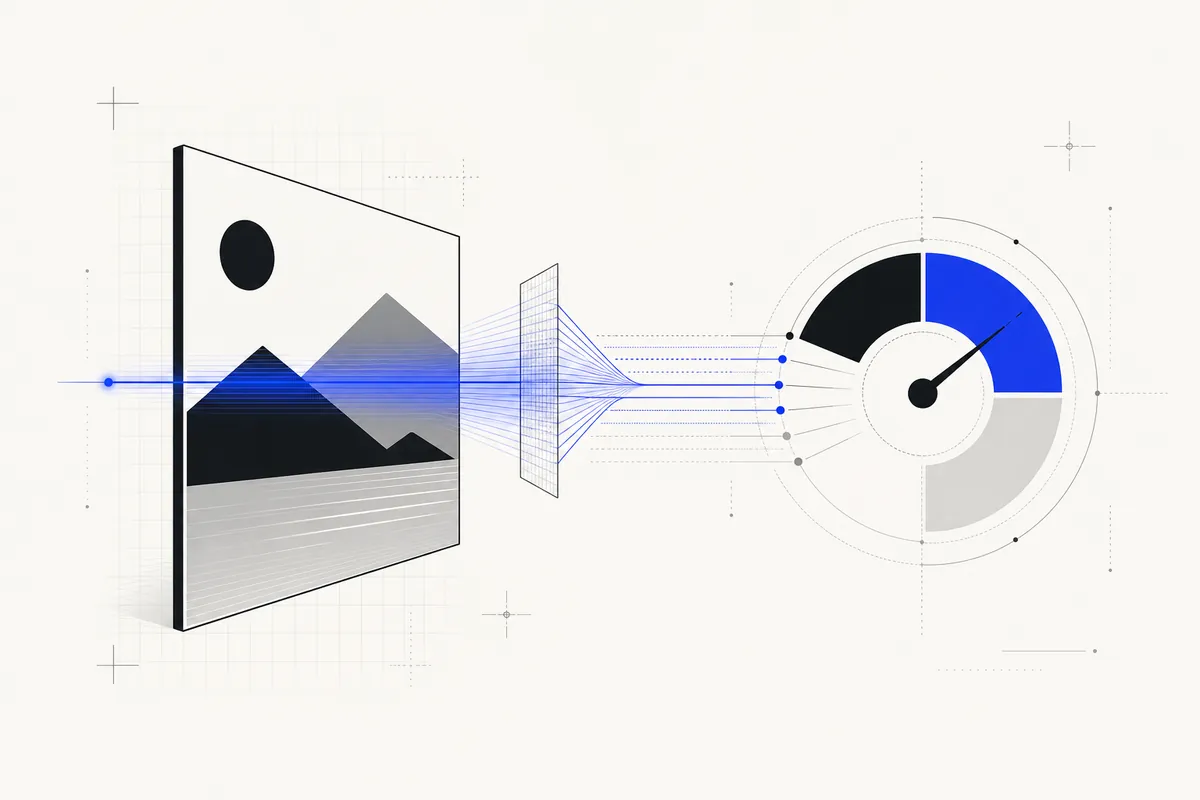
You upload a photo, wait two seconds, and get back "92% likely synthetic." But what actually happened in those two seconds? This guide explains how do AI image detectors work, from the forensic signals they hunt for to the moments they get it wrong.
Direct answer: AI image detectors work by training neural networks to recognize the statistical fingerprints that image generators leave behind: frequency-domain artifacts, unnatural noise patterns, and pixel correlations invisible to the eye. The detector compares your image against these learned patterns and returns a confidence score, not a guarantee.
I build detection systems for a living, so this is the honest version: the four signal families the field relies on, what a confidence score really means, and the failure modes most vendors would rather not discuss.
Ingest the image
The detector reads the pixels and any metadata.
Analyze for artifacts
Models look for statistical patterns generators leave that the eye misses.
Score the verdict
You get Authentic, Likely Synthetic, or Inconclusive with a TrustScore.
The Core Idea: Every Generator Leaves Fingerprints
Color laser printers add nearly invisible yellow microdots to every page, a tracking pattern most people never notice. Digital cameras do something similar by accident: each sensor stamps its own faint noise signature onto every shot. The physical world is messy, and that mess is surprisingly consistent.
AI image generators have their own version of this. To turn random noise into a photo of a face, a model performs millions of mathematical operations, and those operations impose statistical regularities that real cameras never produce. The image can look flawless to you while carrying a kind of manufacturing residue underneath.
Detection is the science of reading that residue. A detector does not "see" a fake the way you would spot a sixth finger. It measures patterns in the pixels, the color channels, and the frequency content, then asks one question: does this look like the output of a camera, or the output of a generator?
The catch is that generators improve constantly, and every new model leaves slightly different traces. That is why detection is a moving target rather than a solved problem, a theme you will see throughout this guide.
AI Image Detection Technology: The 4 Signal Families
Most AI image detection technology draws on four families of signal. Real systems usually combine several at once, but it helps to understand them one at a time. Each one looks at a different layer of evidence in the same image.
Frequency Analysis: Patterns Hidden in the Signal
Every image can be broken down into frequencies, much like a chord can be broken into individual notes. This is the frequency domain, and it is one of the oldest tools in image forensics.
When researchers convert AI images into the frequency domain, they often find tell-tale grid and checkerboard patterns. These come from the upsampling steps a generator uses to scale a small internal representation up to a full-size image. Frank and colleagues documented these spectral artifacts across many generator architectures in their 2020 study (Frank et al., 2020). Real camera photos rarely show the same regular structure, which makes frequency analysis a useful first filter.
Noise Residuals: Cameras Are Messy, Models Are Not
Strip away the visible content of a photo and you are left with noise, the faint random texture from the camera sensor and its processing. This noise residual is like a fingerprint of the capture device.
Generated images carry noise too, but it tends to be wrong in revealing ways: too uniform, too clean, or correlated across the frame in patterns no physical sensor would create. A detector that models what natural sensor noise should look like can flag an image whose noise floor does not add up, even when the picture itself looks perfect.
Learned Classifiers: Neural Networks That Learn From Millions of Examples
The workhorse of modern detection is the learned classifier, usually a convolutional neural network (CNN) or a vision transformer. Rather than being told which artifact to look for, the network studies a large set of labeled real and synthetic images and learns the dividing line on its own.
A landmark result here is Wang and colleagues' 2020 finding that a classifier built from the output of a single generator could generalize to detect images from other, unseen generators (Wang et al., 2020). That suggested many generators share common statistical flaws. The crucial caveat: coverage of new generator families still matters, because each new architecture can move the line. Classifiers detect output from the generator types they have seen examples of, so detection systems need fresh examples as new tools appear.
Provenance and Metadata: Reading the Image's Paper Trail
The fourth family does not analyze pixels at all. It reads the evidence attached to the file: embedded metadata, and increasingly, cryptographic provenance signals.
The leading provenance standard is C2PA, also called Content Credentials, backed by Adobe, Microsoft, OpenAI, Google, and others. It binds tamper-evident records of how an image was made directly to the file (C2PA / Content Credentials). Google's SynthID adds an invisible watermark to images from its own models. When present, these signals are strong evidence. The limit is coverage: most images in the wild carry no provenance data, and ordinary metadata is trivially stripped or faked, so pixel-level analysis still does the heavy lifting.
From Upload to Verdict: What Happens in Two Seconds
Here is the worked example, using our own pipeline. When you upload an image (JPG, PNG, or WEBP, up to 4.5MB, at least 64x64 pixels), four things happen in quick succession.
First, preprocessing: the image is decoded and normalized so the analysis sees a consistent input. Second, analysis: the image is run through our detection models, which weigh signals like the families above. Third, score fusion: those signals are combined into a single calibrated confidence number. Fourth, output: you receive a whole-file verdict, one of Authentic, Likely Synthetic, or Inconclusive, paired with a TrustScore from 0 to 100.
Two design choices are worth calling out. We report high accuracy, and the output is deliberately a whole-image verdict plus confidence, not a region map or a claim about which specific generator made it. Those finer-grained outputs are tempting to show, but they are far less reliable than a calibrated whole-file score, so we do not present them. The same engine covers image, video, and audio detection.
Privacy is part of the pipeline, not an afterthought. Files are deleted from primary storage within 60 seconds of analysis unless you opt into retention. Nothing lingers by default.
How Accurate Are AI Image Detectors?
This is where honesty matters most. Our product reports high accuracy, and it is worth understanding exactly what a number like that does and does not promise.
Accuracy is an average across a test set, not a guarantee for your specific image. It also interacts with base rates. If almost everything you scan is genuine, even a small false-positive rate will produce some wrong "synthetic" calls simply because real images vastly outnumber fakes in your queue. The verdict is evidence, not a verdict in the courtroom sense.
False positives, calling a real photo synthetic, cluster around heavily processed images. A real photo that has been aggressively upscaled, beauty-filtered, or run through repeated compression can pick up artifacts that resemble generator residue. That is one reason results pair a label with a TrustScore: a borderline number is telling you to look closer, not to convict.
False negatives, missing a real fake, cluster around brand-new generators the field has not characterized yet, plus screenshots and recompressed images where the original signal has been degraded. No detector catches everything, and any vendor claiming 100% is selling something. The right posture is to treat a clean result as reassuring evidence, not proof.
When AI Image Detectors Fail (and How the Field Fights Back)
Detection is an arms race, and pretending otherwise would be dishonest. There are three main ways detectors get beaten.
The first is new model releases. Each new generator can shift the statistical fingerprints, so detection coverage has to keep pace with the tools people actually use. The second is adversarial perturbation: tiny, deliberately crafted changes to an image that nudge a single classifier toward the wrong answer. The third is laundering, where a fake is passed through filters, screenshots, or recompression until its tell-tale traces are smeared. (I am describing these conceptually, not as a recipe.)
The field fights back on several fronts. Ensembles that combine multiple independent signals are harder to fool than any one classifier, because an attack that defeats frequency analysis may still trip the noise model. We update our models as new generators appear, so coverage does not freeze in place. And provenance standards like C2PA act as a complementary layer: when a file carries cryptographic Content Credentials, you are no longer relying on artifacts alone. No single defense is complete, which is exactly why serious systems layer them.
FAQ
How do AI image detectors work in simple terms? They pattern-match. A detector learns the statistical fingerprints that image generators leave behind, then compares your image against those patterns and returns a confidence score. It is closer to a forensic lab test than to a human spotting an obvious mistake.
Can AI image detectors be wrong? Yes, in both directions. A false positive flags a real but heavily edited photo as synthetic. A false negative misses a fake from a brand-new generator or a degraded screenshot. That uncertainty is why every result comes with a TrustScore rather than a flat yes or no.
Do detectors work on screenshots of AI images? Often yes, but with reduced reliability. Screenshotting and recompression smear the underlying artifacts a detector depends on, so the signal weakens. A genuine fake can still be detectable, but a borderline TrustScore on a screenshot deserves extra caution.
Can you fool an AI image detector? It is possible, through adversarial tweaks or by laundering an image through filters and recompression. This is the arms race. Detectors that fuse several independent signals are far more resistant than any single classifier, because beating all of them at once is much harder.
Do detectors store my images? Ours does not, by default. Files are deleted from primary storage within 60 seconds of analysis unless you explicitly opt into retention. Privacy is built into the pipeline rather than bolted on.
Conclusion: Trustworthy Tools, Honestly Explained
So how do AI image detectors work? They read the statistical residue that generators leave behind, combine several forensic signals through trained neural networks, and return a whole-file verdict with a TrustScore. They are real science, not snake oil, but they are probabilistic, and they fail in predictable ways that an honest tool should tell you about.
Want to see it for yourself? Scan an image with our AI image detector. Free accounts include 50 detections per month, no card required.