AI Generated Profile Pictures: How to Detect Fake Faces on Dating Apps and LinkedIn
The person messaging you may not exist. The face in their profile picture can be invented from scratch by a model, which means there is no real human behind it and no original photo to trace. Here is how to tell.
- The Two Kinds of Fake Profile Pictures
- How to Spot AI Generated Profile Pictures: 8 Telltale Signs
- Red Flags by Platform
- How to Verify a Profile Picture in 4 Steps
- Check Any Profile Photo with an AI Image Detector
- What to Do If You Confirm a Fake Profile
- FAQ
- Conclusion: Verify Before You Trust Any Profile
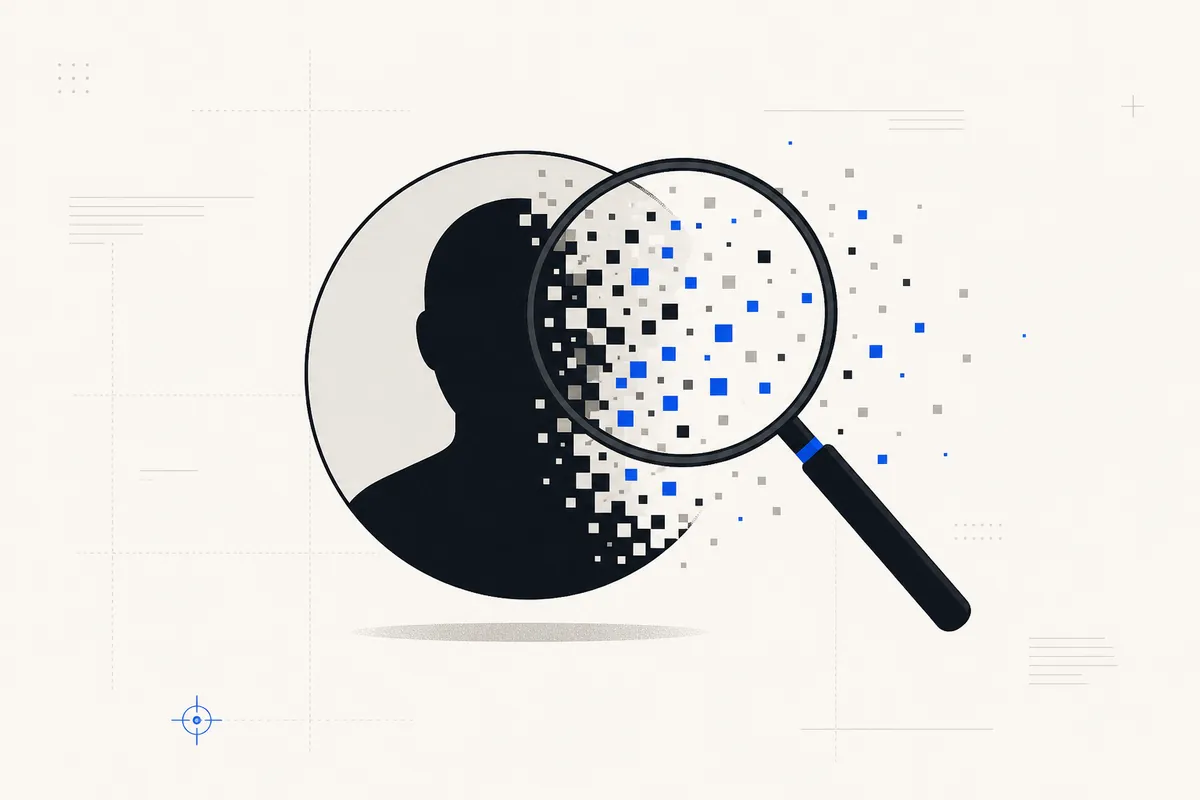
The person messaging you may not exist. The face in their profile picture can be invented from scratch by a model, which means there is no real human behind it and no original photo to trace. Here is how to tell.
The Two Kinds of Fake Profile Pictures
Not every fake profile photo is made the same way, and the two types fail different tests. Knowing which one you are looking at decides how you verify it.
Stolen Photos: The Classic Catfish
The traditional catfish steals a real person's photos, often a model, an influencer, or a stranger from another country. These images have a history. The same face appears on other accounts, on stock sites, or in news articles, because the picture was taken of an actual human being at some point.
That history is your weapon. A reverse image search will usually surface the original, so stolen-photo catfishing is the easier of the two to expose. The catch: it only works when the source is already online and indexed.
AI Generated Faces: The Catfish You Cannot Reverse-Search
The newer threat is a face that was never photographed. Tools built on technology like StyleGAN, and now diffusion models, generate a convincing human face that has never existed. There is no original, no model, no stock listing, so a reverse image search comes back empty.
That empty result is exactly why scammers and bot networks love them. Each fake account gets a unique, untraceable face on demand. Because reverse search fails here, you need a different approach: read the artifacts in the image itself, then confirm with a detector trained to read the statistical fingerprints generators leave behind.
How to Spot AI Generated Profile Pictures: 8 Telltale Signs
These are the artifacts that give away AI generated profile pictures. A quick note on honesty first: the strongest tells below (especially the eye-alignment trick) come from older GAN-era faces. Diffusion-era fakes are more varied and harder to catch by eye, which is why the detector check at the end matters more every year.
- Eyes in the exact same position every time
- Warped or dreamlike background
- Mismatched or single earring
- Asymmetric glasses frames
- Blurred or melting hair strands
- Teeth that blend together
- Stray artifacts near the face edges
- No traceable original via reverse search
1. Identical eye alignment. Faces from the same GAN generator place the eyes in nearly the same spot on every image. If you line up a grid of suspect photos, the eyes sit at one fixed height and spacing. Real photos vary with framing and pose.
2. Background soup. Look behind the subject. AI backgrounds smear into abstract blobs, with door frames, railings, and bookshelves that warp, bend, or dissolve into nonsense.
3. Mismatched or melted accessories. Earrings that do not match between ears, a single earring where there should be two, or glasses frames that fuse into the temple are classic generator failures.
4. Hair dissolving into skin. Trace the hairline and stray strands. AI hair often melts into the forehead or background instead of ending in clean individual strands.
5. Asymmetric collars and clothing. Shirt collars, zippers, and necklines that differ from one side to the other are common, because the model renders each side semi-independently.
6. Single-photo profiles. A real person accumulates photos over time. One lone headshot, especially a polished one, with no casual or candid shots anywhere is a context flag.
7. Odd teeth and ear details. Zoom into small, detailed regions. Too many teeth, blurred or fused ears, and asymmetric ear shapes get less attention from the model than the central face.
8. Too-perfect studio look on a casual account. A flawless, evenly lit, color-graded headshot on an account that otherwise looks ordinary is worth a second look. Generators tend to produce that airbrushed, poreless finish.
No single sign is proof. Two or three together, or one clear sign plus a detector flag, is when you should be genuinely suspicious.
Red Flags by Platform
The same fake face shows up differently depending on where it is deployed. Here is what to watch for in each context.
Dating Apps: Catfish and Romance Scam Patterns
On Tinder, Hinge, and Bumble, the pattern is fast and emotional. Watch for a single stunning photo, rapid escalation of affection, and an early push to move off the app to WhatsApp or Telegram. The biggest tell is a refusal to do a live video call, or excuse after excuse for why the camera will not work.
These behaviors are the front end of AI romance scams, which the FTC reports cost Americans hundreds of millions of dollars a year. According to the FTC's 2024 fraud data, consumers reported losing $12.5 billion to fraud in 2024, with imposter scams among the top categories. If money or crypto enters the conversation, stop.
LinkedIn: Fake Recruiters and Connection Farms
On LinkedIn the fakes wear a generic professional headshot paired with a thin work history and a brand-new account. They send pushy DMs about a job opening, a crypto opportunity, or a vague "partnership."
This is documented, not hypothetical. In 2022, Stanford Internet Observatory researchers Renee DiResta and Josh Goldstein identified more than 1,000 LinkedIn profiles using apparent AI generated faces, many used to drum up sales leads, and LinkedIn removed profiles that broke its policies (NPR, 2022). DiResta first spotted hers from a single earring and the centered eyes.
Social Media: Bot Networks and Sockpuppets
On X, Facebook, and Instagram, AI faces power coordinated bot networks and sockpuppet accounts. You may notice families of faces that look subtly related, accounts that post in lockstep, and profiles with thousands of follows but almost no genuine interaction. One fake face is a person to avoid. A pattern of them is a network.
How to Verify a Profile Picture in 4 Steps
When you have a specific suspicious profile in hand, work through this in order. It moves from free and instant to most conclusive.
- Reverse image search the photo. Save the picture and run it through Google Lens or TinEye. If it traces back to a model, a stock site, or another name, it is a stolen-photo catfish. If it returns nothing, that absence points toward an AI generated face.
- Zoom in on the GAN tells. Check the eyes, background, earrings, and hairline against the 8 signs above. Screenshot and enlarge; the artifacts are easiest to see at high zoom.
- Ask for live proof. Request a live video call or a photo in a specific pose (for example, holding up three fingers). A real person can do this in seconds. A fake account will stall, make excuses, or vanish.
- Run it through an AI image detector. Upload the photo for a verdict and a confidence score. This is your tiebreaker when your eyes are unsure, and it catches the diffusion-era fakes that beat manual inspection.
Check Any Profile Photo with an AI Image Detector
A purpose-built detector is the fastest way to settle the question. Save the profile picture and upload it to our AI image detector. It scans for the statistical fingerprints that image generators leave behind and returns a clear verdict: Authentic, Likely Synthetic, or Inconclusive, paired with a TrustScore from 0 to 100.
The detector achieves high accuracy and accepts JPG, PNG, and WEBP files up to 4.5MB (minimum 64x64 px, so even a small profile thumbnail usually works). Your file is deleted from primary storage within 60 seconds of analysis completion, unless you opt into retention. Free accounts include 50 detections per month, with no card required.
For checking profiles as you browse, the Chrome extension lets you right-click any image on the web and choose "Check with Deepfake Detector" without leaving the page.
What to Do If You Confirm a Fake Profile
If the evidence stacks up, protect yourself first.
- Do not confront them. Tipping off a scammer just tells them which tells to fix next time. Quietly stop responding.
- Report the account on the platform. Dating apps, LinkedIn, and social networks all have a report-profile flow. Use it so others are protected too.
- Report fraud attempts. If money was requested or sent, file with the FTC at ReportFraud.ftc.gov and, for online crime, the FBI's IC3.
- Cut contact and warn your network, especially if the fake was impersonating a colleague or recruiter who could target others.
If you have already been hurt by one of these, you are not foolish, and you are far from alone. Research shows people genuinely cannot reliably tell AI faces from real ones by eye (PNAS, Nightingale and Farid, 2022). These fakes are built to fool everyone. Taking action now is the right move.
FAQ
How can I tell if a profile picture is AI generated?
Check the eyes (older AI faces center them identically), look for warped backgrounds and mismatched earrings, and confirm with an AI image detector. Reverse image search helps too: AI faces usually return no matches, which is itself a clue.
Can reverse image search find AI generated faces?
Usually not. An AI generated face was never photographed, so there is no original online to match. A blank reverse-search result is exactly why scammers prefer AI faces, and exactly why a detector check matters more than a reverse search here.
Are fake profile pictures illegal?
It depends on intent and jurisdiction. Using a fake face for fraud, impersonation, or financial scams can break laws even when generating a face does not. Romance and investment scams are prosecutable fraud regardless of how the photo was made.
How common are AI profile photos in scams?
Documented at scale. Stanford Internet Observatory researchers found over 1,000 LinkedIn profiles using apparent AI faces in a single 2022 investigation (NPR, 2022), and the technique has only grown easier and cheaper since.
Can a detector check a low-resolution profile photo?
Yes, with caveats. The detector accepts images as small as 64x64 px, so most profile thumbnails work. Heavy compression and tiny file sizes strip away signal, so a low-resolution photo is more likely to return an Inconclusive verdict than a sharp one.
Conclusion: Verify Before You Trust Any Profile
AI generated profile pictures have made the old advice ("just reverse-search it") only half the answer. Stolen photos still trace back, but invented faces do not, so you need both the manual GAN tells and a forensic check. Read the eyes, the background, and the accessories, ask for live proof, and let a detector break the tie. A few minutes of verification is cheaper than the alternative. Platforms screening accounts and uploads can use our synthetic media detection for trust and safety.