Is This Image AI Generated? Run This 12-Point Checklist
You have an image open right now and you need a verdict. This page gives you two ways to get one: a 10-second automated check or a 12-point manual checklist.
- The Fastest Answer: Check Your Image in 10 Seconds
- Is This Image AI Generated? The 12-Point Manual Checklist
- How to Score Your Checklist Results
- What a Detector's Confidence Score Actually Means
- FAQ
- Conclusion: Get Your Answer, Then Trust It
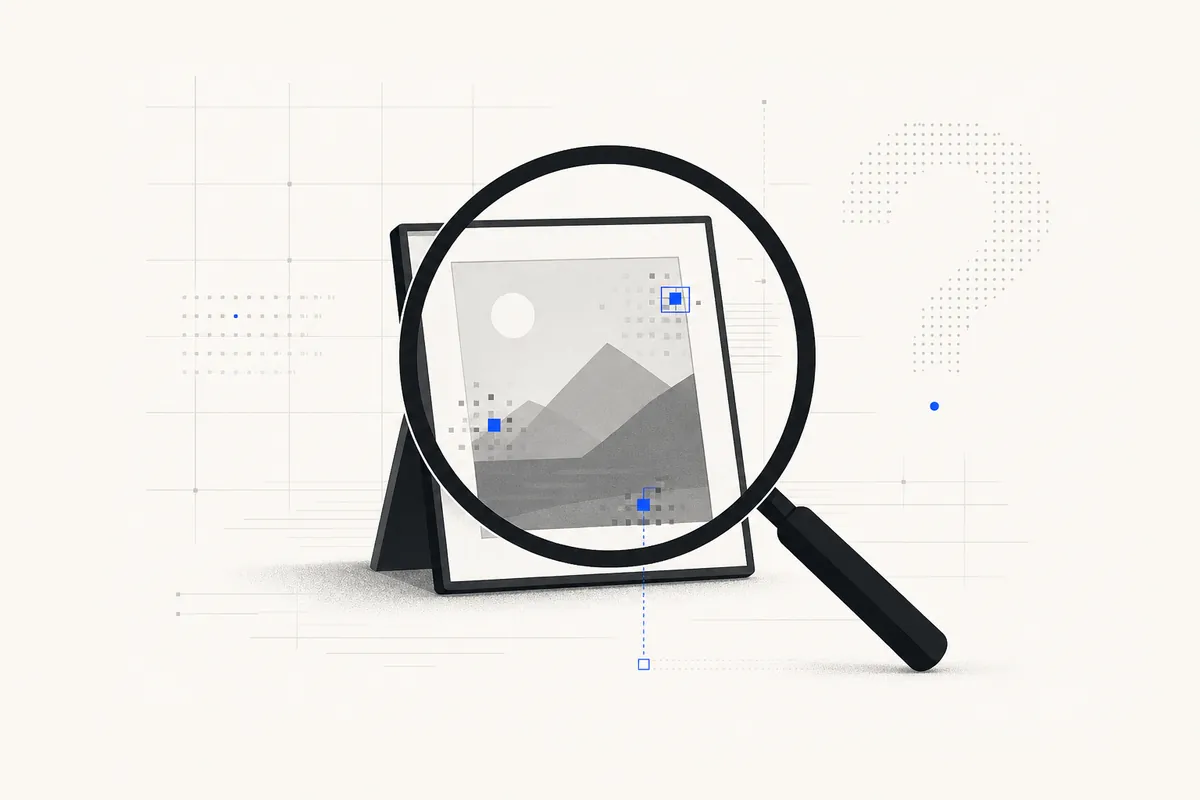
You have an image open right now and you need a verdict. This page gives you two ways to get one: a 10-second automated check or a 12-point manual checklist.
Direct answer: To find out if an image is AI generated, upload it to a free AI image detector for an instant confidence score, or work through a manual checklist: inspect hands, text, lighting, reflections, and textures, then check the metadata and reverse-search the image to trace its origin.
The Fastest Answer: Check Your Image in 10 Seconds
A purpose-built detector is faster and more reliable than your eyes. Here is the whole process:
- Upload the image to the free AI image detector. No card required, and free accounts include 50 detections per month.
- Let the analysis run. The detector scans for the statistical fingerprints that generators like Midjourney, DALL-E, and Stable Diffusion leave behind.
- Read your result. You get an AI or Human verdict plus a TrustScore from 0 to 100, so you know how confident the call is.
Your file is deleted from primary storage within 60 seconds of analysis completion, unless you opt into retention.
Is This Image AI Generated? The 12-Point Manual Checklist
Cannot upload the image, or want to confirm the detector's call? Work through these 12 checks. Score one flag for every check the image fails.
- Warped hands or fingers
- Mismatched or asymmetric facial features
- Waxy, too-smooth skin
- Teeth or eyes that look off
- Garbled background text or signage
- Lighting and shadows that disagree
- Impossible reflections
- Melted or repeating background objects
- No or stripped metadata
- Reverse image search finds no original
- Source account is new or unverifiable
- The image appears on only one site
Face and Body Checks (1-4)
1. Hands and fingers. Count the fingers and look at the joints. Generators still fumble hands more than any other body part because hands appear in endless poses in training data.
2. Teeth and ears. Look for too many teeth, merged teeth, or earrings that do not match. These small, detailed regions get less attention from the model than the face itself.
3. Eyes and reflections. Check that both eyes catch light from the same direction. Mismatched catchlights are a classic giveaway because models render each eye semi-independently.
4. Skin texture. Zoom in on cheeks and foreheads. AI skin often looks airbrushed and poreless, or shows a waxy sheen that real photos rarely have.
Scene Checks (5-8)
5. Text and logos. Read any signs, labels, or shirts in the image. Generators produce garbled, alien-looking lettering because they paint the shape of text, not actual words.
6. Lighting and shadow direction. Trace the shadows. If the sun is on the left but a shadow falls left too, the scene was assembled, not photographed.
7. Background melt. Look at the edges of objects behind the subject. AI backgrounds often smear into one another, with fences, railings, and windows that warp or dissolve.
8. Repeating patterns. Scan crowds, foliage, and textures. Generators copy-paste at a statistical level, so you may find the same face, leaf, or window twice.
Source Checks (9-12)
9. Reverse image search. Run the image through Google Lens or reverse image search. If it only exists on one account posted yesterday, treat it with suspicion.
10. Metadata and content credentials. Check the file at the Content Credentials verify tool. Some generators and cameras now attach C2PA provenance data, and EXIF metadata can reveal editing software.
11. Account history of the poster. Look at who shared it. Brand-new accounts, stolen bios, and feeds full of suspiciously perfect photos are context flags that matter as much as pixels.
12. Does an original exist? Search for a higher-resolution or earlier version. Real photos usually have a source: a news wire, a photographer, an event. AI images appear from nowhere.
How to Score Your Checklist Results
Add up your flags and use this rubric:
| Flags | Verdict | Next step |
|---|---|---|
| 0-1 | Likely real | Still verify the source if the stakes are high |
| 2-3 | Suspicious | Run it through the free AI image detector |
| 4+ | Probably AI | Treat as synthetic until proven otherwise |
The detector is your tiebreaker. Human eyes are genuinely bad at this: a 2022 study by Nightingale and Farid published in PNAS found that people could not reliably distinguish AI-synthesized faces from real ones, and even rated the fakes as more trustworthy (PNAS, 2022).
What a Detector's Confidence Score Actually Means
A confidence score is a probability, not a certainty. Our detector achieves high accuracy, which means it is right far more often than human reviewers, but no detector on the market is infallible.
Here is how to read your result:
- High confidence either way: trust the verdict, especially when it agrees with your checklist.
- Mid-range score: treat it as inconclusive. Compression, cropping, and filters strip away the signal detectors rely on.
- Detector and checklist disagree: weight the source checks (9-12). Provenance beats pixels.
If you want the deeper mechanics, read how AI image detectors work. And for high-stakes calls, a second opinion from another tool or a human expert is always reasonable.
FAQ
How can I check if an image is AI generated for free?
Upload it to the free AI image detector. Free accounts include 50 detections per month with an AI or Human verdict and a TrustScore from 0 to 100. Pair the result with the 12-point manual checklist above for a confident answer.
Is there an app to tell if an image is AI?
Yes. The detector runs in your browser with no install, and the Chrome extension lets you right-click any image on the web and check it without leaving the page.
Can ChatGPT tell if an image is AI generated?
Not reliably. A vision chatbot describes what an image looks like and makes an educated guess. A forensic detector measures statistical artifacts the generation process leaves in the pixels. Chatbots are useful assistants, but they were never trained for image forensics.
What if the detector says 50/50?
Treat it as inconclusive. Find a higher-resolution original, run the source checks from the checklist, and try a second detection tool. Heavy compression and small file sizes are the most common causes of inconclusive results.
Does a missing watermark mean the image is real?
No. Most AI images carry no visible watermark at all, and invisible watermarks are easily stripped by cropping or re-saving. Absence of a watermark tells you nothing either way.
Conclusion: Get Your Answer, Then Trust It
So, is this image AI generated? Run the 12 checks, score the flags, and let the detector break any tie. Manual review catches the obvious fakes, and forensic analysis catches the ones your eyes miss. For full training on visual tells, see our guide on how to tell if an image is AI generated, and if you are vetting profile photos specifically, start with AI generated profile pictures.