Voice Cloning Scams: Real Cases, Warning Signs, and a Family Playbook
---
- How Voice Cloning Scams Work
- Real Voice Cloning Scam Cases, Documented
- 8 Warning Signs of a Voice Cloning Scam Call
- The Family Playbook: Set This Up in 10 Minutes
- What to Do During and After a Suspected Scam Call
- Can You Detect a Cloned Voice? Yes, Here Is How
- FAQ
- Conclusion: One Code Word Beats a Perfect Clone
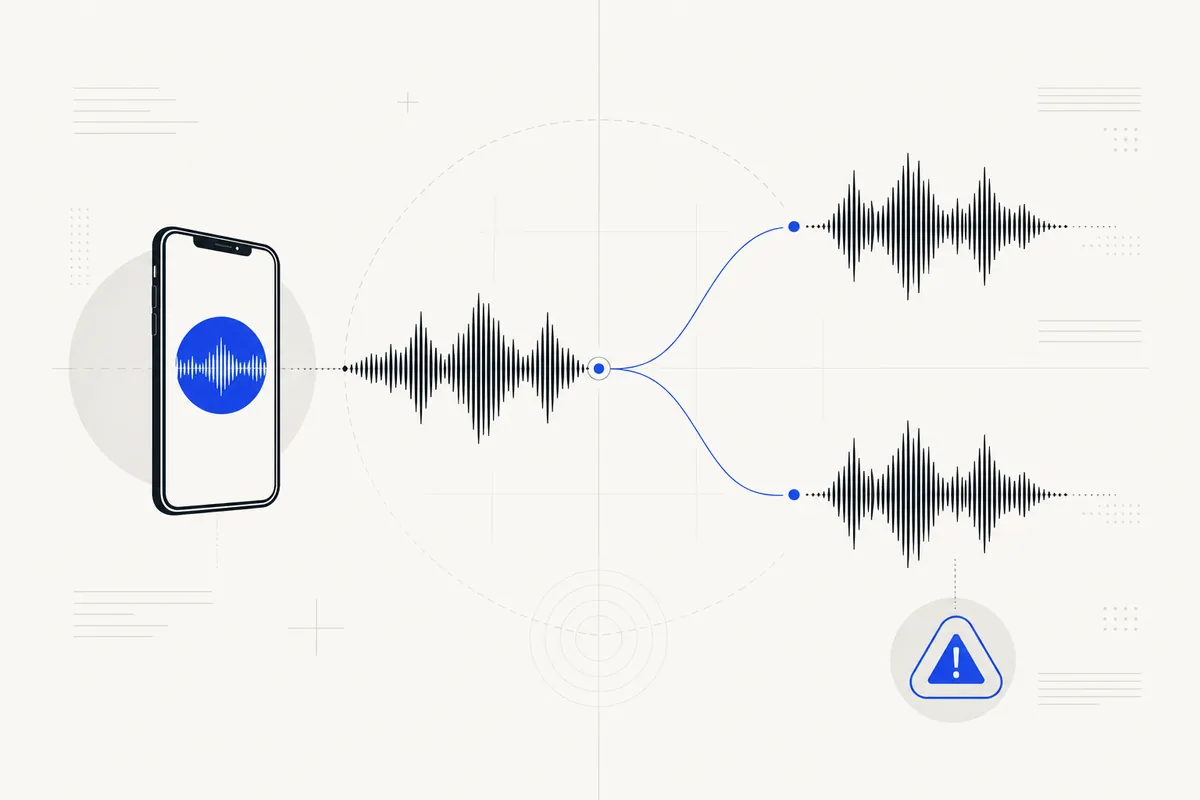
In April 2023, Jennifer DeStefano answered a call from an unknown number. She heard her 15-year-old daughter sobbing, then a man demanding $1 million for her safe return. Her daughter was never in danger. The voice was an AI clone, and DeStefano had nearly become one more victim of voice cloning scams.
Voice cloning scams are no longer rare. The FTC reported that impostor scams cost Americans more than $3.5 billion in 2025, the most common fraud category of the year. And the FBI's 2025 IC3 report logged over 22,000 complaints involving AI, with nearly $900 million in losses.
This guide documents real cases with dates and dollar amounts, breaks down how the scam works, and gives your family a 10-minute playbook to shut it down.
What is a voice cloning scam? Voice cloning scams use AI to copy a loved one's voice, then stage a fake emergency call demanding money. Scammers need only seconds of audio from social media. Protect your family with a code word, callback verification, and an AI voice detector before sending anything.
How Voice Cloning Scams Work
Every voice cloning scam follows the same four-stage pattern. Knowing the pattern is half the defense.
- Harvest. The scammer collects a short sample of the target's voice.
- Clone. Free or cheap AI tools turn that sample into a synthetic voice that can say anything.
- Call. The scammer phones a family member with a fake emergency, often spoofing the caller ID.
- Cash out. Payment is demanded through wire transfer, gift cards, cash couriers, or crypto, channels that are hard to reverse.
Where scammers harvest your voice
Scammers do not need much. McAfee's 2023 Beware the Artificial Impostor report found that just three seconds of audio was enough to produce a clone with an 85 percent voice match. With a few more clips, McAfee researchers reached a 95 percent match.
Common harvest sources include:
- Public videos on TikTok, Instagram, YouTube, and Facebook
- Voicemail greetings recorded in your own voice
- "Wrong number" or survey calls designed to record you talking
- Podcasts, livestreams, school events, and local news clips
The script: urgency, secrecy, and untraceable payment
The call itself is classic vishing with an AI upgrade. The cloned voice delivers a few emotional lines, then a "police officer," "lawyer," or "kidnapper" takes over. The script always pushes three buttons: act now, tell no one, and pay in a way that cannot be recalled. The FTC's consumer alert on family emergency schemes warns that demands for wire transfers, crypto, or gift cards are the signature of the scam.
Real Voice Cloning Scam Cases, Documented
Competing articles talk about voice cloning scams in the abstract. These two cases are documented with dates, locations, and amounts.
Jennifer DeStefano: the $1M fake kidnapping call (Arizona, 2023)
- Date and place: April 2023, Scottsdale, Arizona
- The call: DeStefano heard what sounded exactly like her daughter Briana crying for help. A man then claimed to have kidnapped the girl and demanded $1 million, later dropping the demand to $50,000 in cash.
- The truth: Her daughter was safe on a ski trip the entire time. The sobbing voice was an AI clone.
- Outcome: DeStefano confirmed her daughter's safety before paying, so no money was lost. The $1 million demand is the anchor figure, not a loss. She testified about the call before the Senate Judiciary Committee on June 13, 2023, and her written testimony is public on judiciary.senate.gov.
The Hyderabad voice clone scam (India, 2023)
- Date and place: 2023, Hyderabad, India
- The call: A 59-year-old woman received a late-night call from someone who sounded exactly like her nephew in Canada. The cloned voice said he had been in an accident, faced jail, and needed money quietly.
- Outcome: She transferred about 1.4 lakh rupees, roughly $1,688, before the family discovered the fraud. The case was reported by IndiaAI, the Indian government's AI portal.
What these cases have in common
Different continents, different amounts, identical mechanics. Both calls came at emotionally vulnerable moments, both voices sounded right to people who knew them best, and both scripts demanded urgency and secrecy. Neither victim was careless. The voice itself was the weapon, which is why verification habits, not good hearing, are the fix.
- An urgent emergency demanding money now
- A request to keep it secret
- Caller pressures you to stay on the line
- Payment by gift card, wire, or crypto
- The number is unknown or spoofed
- The story cannot be verified independently
- The voice avoids personal questions
- It plays on fear about a loved one
8 Warning Signs of a Voice Cloning Scam Call
Treat any emergency call as suspect if you notice even one of these signs. Two or more means hang up and verify.
- Unknown or spoofed number. The "family member" calls from a number you do not recognize, or caller ID looks right but feels off. Caller ID spoofing is trivial.
- Extreme urgency. Money is needed in minutes, not hours. Real emergencies allow time to verify.
- A demand for secrecy. "Don't tell Dad." "Don't call the police." Secrecy only helps the scammer.
- Untraceable payment. Wire transfer, gift cards, crypto, or a cash courier. No legitimate authority collects ransom or bail this way.
- Refusal to answer personal questions. The voice dodges questions only the real person could answer.
- Call quality excuses. "Bad connection" or background noise that conveniently masks flaws in the clone.
- A script that runs on emotion. Crying, panic, and threats arrive before any verifiable detail.
- Resistance to a callback. Any pushback against "I'll call you right back on your number" is a red flag.
The Family Playbook: Set This Up in 10 Minutes
This is the part to print. One short family conversation defeats the entire scam category. Walk through these four steps tonight.
Step 1: Pick a family code word (and how to use it)
Choose one word or phrase that never appears on social media. Odd combinations work best, something like "purple lawnmower." The rule: on any emergency call involving money, ask for the code word. No code word, no money, no exceptions.
Use this setup script at dinner or in the family group chat: "Scammers can copy our voices with AI now. If anyone ever calls needing money urgently, we ask for the code word first. Our word is ______. Never post it, never text it to strangers, never say it unless asked on an emergency call."
Step 2: Agree on a callback rule
The code word's backup. If a call feels wrong, hang up and call the person back on the number saved in your phone. The FTC's guidance on family emergency scams says exactly this: do not trust the voice, call the person directly on a number you know is theirs.
Step 3: Lock down voice sources on social media
You cannot remove your voice from the internet, but you can shrink the sample pool:
- Set personal accounts with voice or video content to private
- Replace custom voicemail greetings with the default robotic greeting
- Do not answer questions from unknown callers; silence gives scammers nothing to record
- Think before posting long videos of kids and elderly relatives talking
Step 4: Brief the most-targeted family members
Older adults are hit hardest. The FBI's 2025 IC3 report shows Americans aged 60 and over lost $7.7 billion to online fraud in 2025, up roughly 60 percent from 2024. Walk grandparents through the code word and callback rule personally, and rehearse the script once. A 2-minute rehearsal beats a lecture.
What to Do During and After a Suspected Scam Call
During the call: do not confirm names, do not volunteer details, and do not stay on the line under pressure. Hang up. Scammers count on keeping you talking.
Immediately after:
- Call the real person on their saved number, or call someone physically near them.
- Do not send anything until identity is confirmed with the code word or a callback.
- If money already moved, call your bank or payment provider now. Recovery odds drop by the hour.
- Report the call to the FTC at reportfraud.ftc.gov and to the FBI at ic3.gov. Reports build the case data that gets these operations shut down.
- Save the number, voicemails, and any messages as evidence. For a full step-by-step recovery guide, see our deepfake scam response playbook.
Can You Detect a Cloned Voice? Yes, Here Is How
Start with your ears. In 30 seconds, listen for flat emotional tone, oddly even pacing, missing breath sounds, and unnatural pauses. Our guide on how to detect deepfake audio covers the by-ear checks in depth.
Then verify with a tool. If you receive a suspicious voicemail or voice note, upload it to our AI voice detector. You get an AI or Human verdict and a TrustScore from 0 to 100 in seconds. The free plan includes 50 detections per month with clips up to 2 minutes each, which covers nearly every scam voicemail.
Remember the order of operations: no detector replaces the code word and callback rule. Use detection as a second layer, not the only layer.
CTA: Suspicious voice message? Check it free: 50 detections per month, files deleted within 60 seconds of analysis. Create a free account
FAQ
How do scammers clone a voice? They feed a short public audio clip into AI voice cloning software. McAfee's 2023 research showed three seconds of audio can produce an 85 percent voice match, and a handful of clips can reach 95 percent.
What is the safe word trick for AI scams? A pre-agreed code word that only family members know. On any emergency call asking for money, ask for the word. A cloned voice cannot answer because the scammer never had access to it.
Are voice cloning scams common? Yes, and growing. The FTC reported over $3.5 billion in impostor scam losses in 2025, and Pindrop's 2025 Voice Intelligence and Security Report measured a more than 1,300 percent surge in deepfake fraud attempts in contact centers during 2024.
Can I get my money back after a voice scam? Sometimes, if you act fast. Contact your bank or payment provider immediately, then report to the FTC at reportfraud.ftc.gov and the FBI at ic3.gov. Wire transfers and gift cards are the hardest to recover.
Who do voice cloning scams target most? Older adults and parents are the prime targets, which is why grandparent scams are their own category. Executives and finance employees are also hit through fake boss calls at work.
Conclusion: One Code Word Beats a Perfect Clone
Voice cloning scams work because the voice sounds right and the moment feels urgent. The defense does not require any technology: a family code word, a callback rule, and locked-down voice sources defeat the scam before it starts. Set up the playbook tonight, brief the grandparents this week, and when a suspicious recording lands in your inbox, run it through our AI voice detector before you act.
CTA: Protect your family in minutes. Check any suspicious voice message free, 50 detections per month. Get started free